
GLP-1 access is changing in 2026, and the impact goes beyond prescribing. The Medicare GLP-1 Bridge, the arrival of an oral GLP-1 option, and evolving prior authorization processes are creating new demands around eligibility verification, documentation, reimbursement, and denial management.
For healthcare practices treating obesity, diabetes, and related conditions, these changes can affect both patient access and revenue cycle operations. The question for practice owners is no longer simply whether patients want GLP-1 therapy. It is whether the practice has the workflow to manage the coverage, authorization, documentation, and billing requirements that come with it.
GLP-1 Shift: What has Changed in 2026
Several developments are changing how practices manage GLP-1 therapy this year.
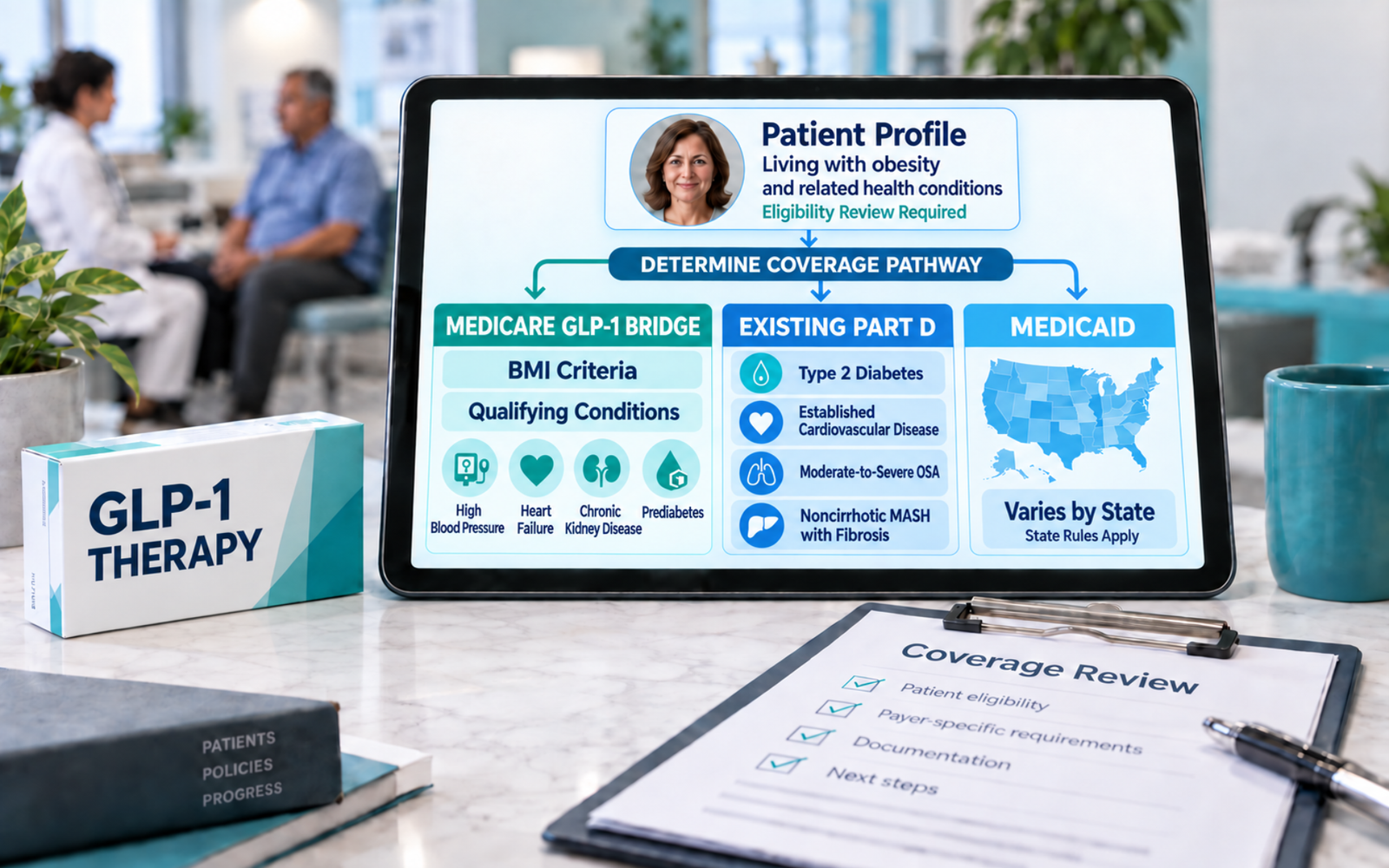
The Medicare GLP-1 Bridge began July 1, 2026, and is scheduled to run through December 31, 2027. It is a short-term CMS demonstration that provides eligible Medicare Part D beneficiaries access to certain GLP-1 drugs for weight management. It is worth remembering that the Bridge operates outside the normal Part D coverage and payment flow. For practices, this means GLP-1 billing and authorization cannot be treated as one standardized process across every patient and payer.
What Does the Medicare GLP-1 Bridge Mean for Practices?
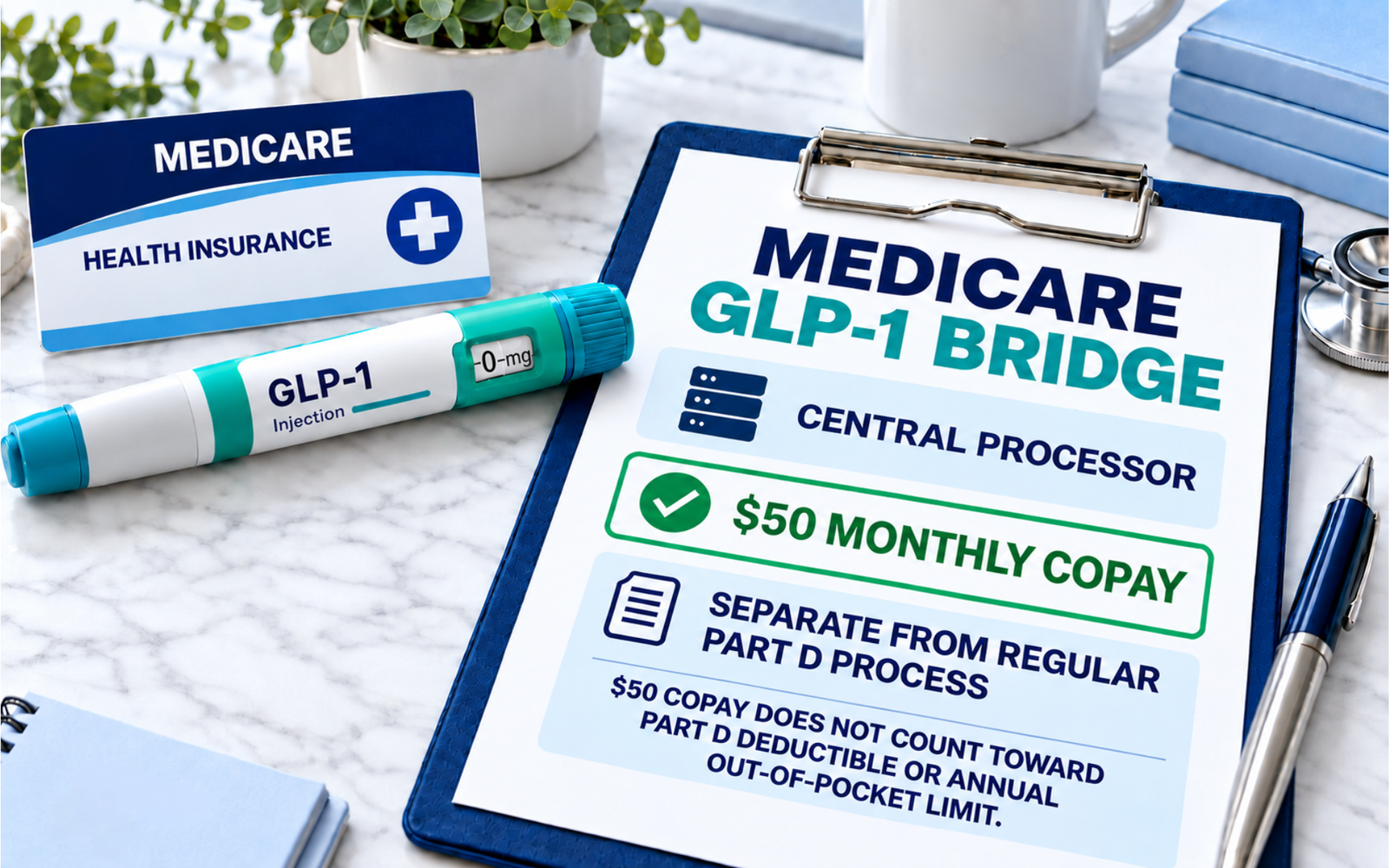
The Medicare GLP-1 Bridge is one of the most important GLP-1 reimbursement developments for practices in 2026.
CMS currently lists Foundayo, Wegovy, and the KwikPen formulation of Zepbound as eligible products for the covered weight-management use. Patients must also meet the program's eligibility requirements.
How the Medicare GLP-1 Bridge Works
The Bridge operates outside the standard Medicare Part D benefit. In 2026, CMS is using a central processor to manage prior authorization, claims adjudication, and pharmacy payment. Eligible beneficiaries have a $50 copay. The copay does not count toward the Part D deductible or true out-of-pocket costs. This distinction matters operationally. Staff should not assume that a GLP-1 prescribed for weight management will move through the patient's normal Part D process. The prescription, pharmacy claim, and prior authorization process need to follow the Bridge requirements.
Who May Qualify for the Medicare GLP-1 Bridge?
Eligibility depends on Medicare enrollment, the reason for treatment, and specific clinical criteria.
CMS requires patients to meet defined BMI and qualifying-condition criteria based on their circumstances and the timing of GLP-1 therapy initiation.
The Bridge is specifically intended for weight-management use. Patients receiving GLP-1 therapy through Part D for certain covered indications, including type 2 diabetes, moderate to severe obstructive sleep apnea, or qualifying MASH, follow the applicable Part D pathway rather than the Bridge for those indications.
That makes accurate eligibility verification an important part of the workflow.
What the $50 Copay Means for Workflow
The $50 copay does not mean every Medicare patient seeking weight-management treatment automatically qualifies.
The practice still needs to verify whether the patient meets the Bridge criteria and whether the prescription is being used for an eligible indication.
The practical takeaway is simple:
Verify the coverage pathway before assuming the prescription will process through the patient's normal Part D benefit.
How the New Oral GLP-1 Option Could Affect Practice Workflows
Another significant development in 2026 is the FDA approval of Foundayo, the oral GLP-1 receptor agonist orforglipron.
The FDA approved Foundayo on April 1, 2026, for use with a reduced-calorie diet and increased physical activity to reduce excess body weight and maintain weight reduction in adults with obesity or adults with overweight plus at least one weight-related comorbid condition.
For practices, the significance goes beyond the medication itself.
An additional oral treatment option can affect:
- Patient demand
- Prescription volume
- Coverage verification
- Prior authorization
- Formulary checks
- Documentation
- Follow-up
- Renewal workflows
As treatment options expand, practices need to make sure another GLP-1 pathway does not create another administrative bottleneck.
Standardized intake, eligibility verification, documentation, and renewal tracking can help keep the process manageable.
GLP-1 Prior Authorization and Documentation Requirements
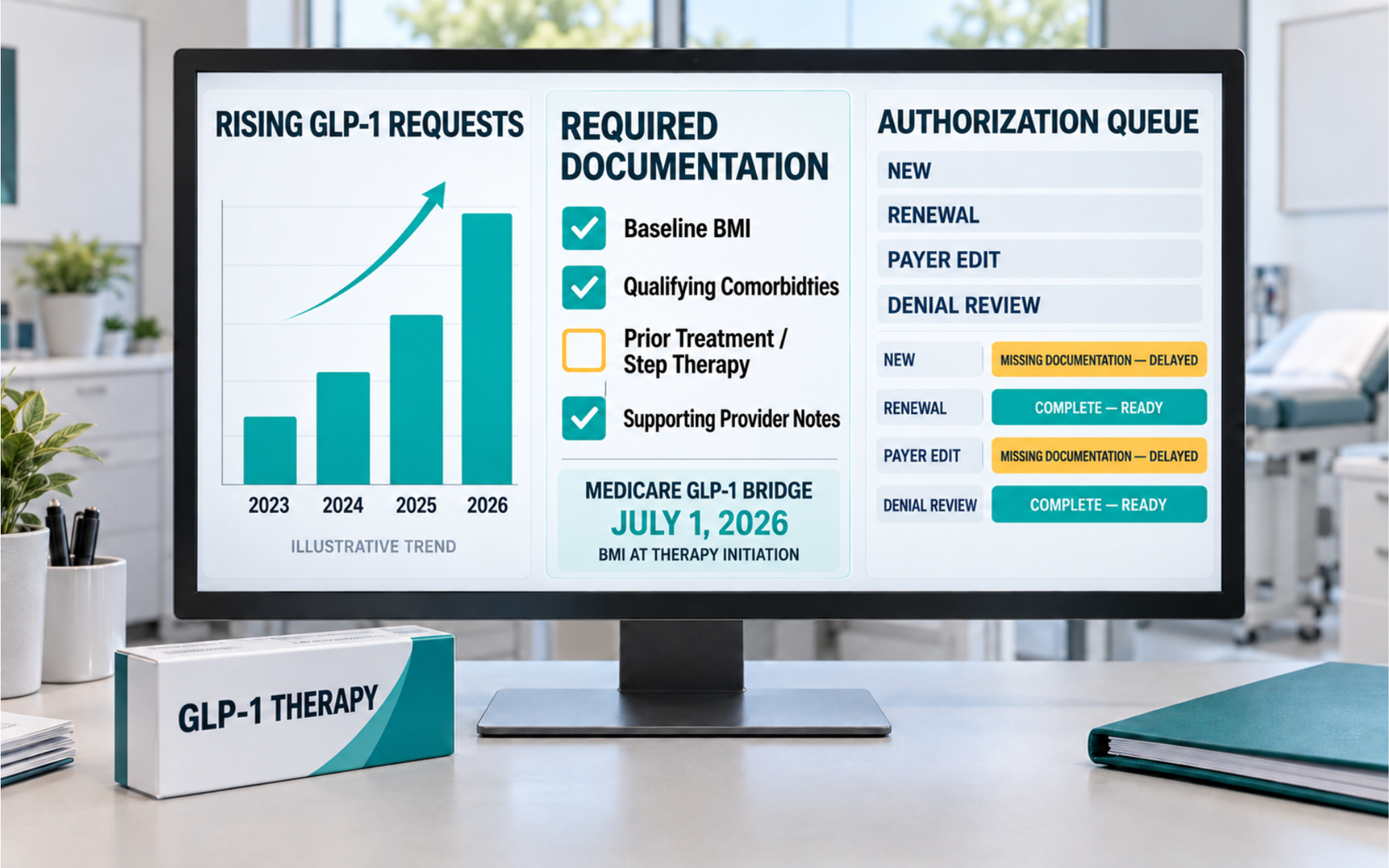
Prior authorization is one of the biggest operational challenges associated with GLP-1 therapy.
Requirements vary by payer, product, indication, and plan. However, practices may need documentation covering:
- BMI and weight history
- Qualifying comorbidities
- Previous treatment history
- Diagnosis and indication
- Payer-specific requirements
- Renewal criteria
- Supporting clinical documentation
The Medicare GLP-1 Bridge also shows why historical information can matter. Bridge eligibility is based on specific clinical criteria at the time GLP-1 therapy was initiated, so practices may need to locate historical BMI information rather than relying only on current measurements.
BMI and Weight History
BMI is particularly important for weight-management indications. The record should contain the relevant height, weight, BMI, and treatment history needed to support the applicable coverage criteria. Practices should not assume that a current BMI will answer every payer's question.
Qualifying Comorbidities
BMI may not be the only factor considered by a payer. Depending on the drug, indication, and coverage policy, documentation may need to establish qualifying conditions or risk factors. The issue is often not that the condition is absent. It may be that the condition is buried in an older note or not clearly connected to the treatment decision.
Previous Treatment History
Some payer policies require documentation of previous treatment attempts or step therapy. When applicable, the record should identify what was tried, how long it was used, the outcome, and why the previous approach was inadequate, poorly tolerated, or otherwise unsuitable. Specific documentation is more useful than vague statements such as "failed conservative treatment."
Payer-Specific Requirements
GLP-1 authorization requirements are not identical across payers.
Differences may include:
- Covered products
- Diagnosis requirements
- BMI criteria
- Step therapy
- Required forms
- Supporting documentation
- Renewal requirements
A current payer-specific reference or authorization checklist is more reliable than relying on staff memory.
Renewal Documentation
Initial authorization is only one part of the process.
Renewals may require updated clinical information showing continued eligibility or response to treatment. Practices should track authorization expiration dates and start renewals early enough to address documentation gaps.
Common GLP-1 Billing and Documentation Problems
GLP-1 billing problems often begin before a claim or authorization is submitted.
Incomplete information, inconsistent documentation, incorrect payer requirements, and unclear ownership can all create avoidable delays.
Missing BMI Documentation
An absent, outdated, or inconsistent BMI can create problems when weight-related eligibility criteria apply.
Practices should capture the relevant height, weight, BMI, and clinical context during the appropriate encounter.
Incomplete Comorbidity Documentation
A qualifying condition may exist in the patient's chart without being adequately connected to the GLP-1 treatment decision.
The documentation should clearly identify the relevant condition and explain its relationship to the treatment plan when required.
Missing Treatment History
When step therapy or previous treatment is part of the payer's criteria, missing history can delay authorization.
The record should include previous medications or interventions, duration, response, intolerance, contraindications, or other relevant details when applicable.
Incorrect Payer Requirements
Using the same authorization workflow for every payer creates avoidable errors.
A request may be submitted with the wrong form, incomplete documentation, an unsupported product, or missing requirements.
A current payer matrix can help staff verify requirements before submitting the request.
Prior Authorization Renewal Problems
Renewals can fail when staff do not have enough time to collect updated clinical information.
Starting the process early gives the practice time to obtain documentation, submit the request, and resolve issues before the existing authorization expires.
How GLP-1 Denials Affect Practice Revenue
A GLP-1 denial is more than a reimbursement problem.
It can create additional work across the practice, including:
- Rechecking benefits
- Reviewing documentation
- Contacting the payer
- Contacting the pharmacy
- Communicating with the patient
- Requesting additional information
- Resubmitting an authorization
- Reviewing denial reasons
- Coordinating with the provider
That administrative work can accumulate quickly.
Denials can also create provider time leakage when clinicians have to revisit documentation or respond to payer questions after the initial submission.
This is why GLP-1 denial management should be treated as part of the revenue cycle rather than as an isolated authorization issue.
The goal is not simply to appeal more denials. It is to identify why they happen and fix the workflow producing them.
How to Build an Efficient GLP-1 Billing Workflow
An efficient GLP-1 workflow starts before the prescription is submitted.
Patient Intake → Eligibility Verification → Documentation → Prior Authorization → Claim Submission → Denial Management → Renewal Tracking
Each stage should have clear ownership.
Patient Intake
The intake process should capture the information needed for coverage and clinical review.
Depending on the indication and payer, this may include:
- Height
- Weight
- BMI
- Diagnosis
- Comorbidities
- Previous therapies
- Current medications
- Relevant contraindications
- Insurance information
Patients should also understand that receiving a prescription does not necessarily guarantee coverage.
Eligibility Verification
Eligibility verification should occur before or around the time of prescribing whenever possible.
Staff should confirm:
- Whether the drug is covered
- Whether it falls under the pharmacy or medical benefit
- Whether prior authorization is required
- Whether step therapy applies
- Whether the product is preferred
- Whether the plan excludes weight-management medications
This can prevent staff from spending time on an authorization for a product the plan does not cover.
Documentation
Documentation should answer the payer's likely questions without requiring repeated chart review.
The record should support the diagnosis, relevant clinical criteria, treatment history, rationale, and follow-up plan.
Templates can improve consistency, but they should still be customized to the patient's actual clinical history.
Prior Authorization
The authorization process should have a defined workflow.
Assigned staff should know:
- Which payer criteria apply
- Which submission method to use
- Which documentation is required
- Who reviews incomplete requests
- Who follows up on pending requests
- What happens after a denial
CMS-0057-F is part of the broader move toward more structured and electronic prior authorization processes. Certain operational provisions have compliance dates beginning in 2026, while several API requirements begin in 2027.
The rule is broader than GLP-1 medications and should not be treated as a GLP-1-specific regulation.
Its relevance to practices is the wider shift toward more structured prior authorization workflows.
Claim Submission
GLP-1 drug access and professional service billing should not be treated as the same process.
Depending on the medication and coverage arrangement, the drug may be processed through a pharmacy benefit while the practice separately bills for eligible evaluation, management, counseling, monitoring, or other professional services.
The billing workflow should clearly distinguish medication access from the professional services associated with managing the patient's care.
Denial Management
Denial management should be structured rather than reactive.
Denials can be categorized by causes such as:
- Missing BMI information
- Incomplete documentation
- Step-therapy requirements
- Non-covered benefit
- Non-preferred product
- Missing renewal information
- Incorrect submission
Tracking these patterns can show where the practice's workflow needs improvement.
An appeal or resubmission should address the stated reason directly and point to the supporting documentation.
What Practices Should Know About Compounded GLP-1 Billing
Compounded GLP-1 products require additional caution. FDA has taken action involving non-FDA-approved compounded GLP-1 products and has stated concerns about certain mass-marketed compounded products.
FDA also proposed changes involving semaglutide, tirzepatide, and liraglutide on the 503B bulks list in 2026. For practices, compounded GLP-1 billing should not be treated as interchangeable with billing or coverage for FDA-approved products.
Coverage, payer policy, pharmacy arrangements, and regulatory requirements can vary. Practices involved with compounded GLP-1 products should verify current requirements rather than assuming that a compounded product follows the same reimbursement pathway as an FDA-approved product.
GLP-1 Billing Best Practices for Practice Owners
Practice owners should approach GLP-1 billing as a systems issue.
A scalable process should include:
- Standardized intake
- Early eligibility verification
- Complete clinical documentation
- Payer-specific authorization checks
- Clear ownership of each authorization
- Proactive renewal tracking
- Structured denial categorization
- Regular workflow review
It is also useful to monitor:
- Authorization approval rate
- Denial rate
- Appeal or resubmission volume
- Average authorization turnaround time
- Renewal completion before expiration
- Staff time per authorization
- Common denial reasons
These metrics can show where administrative work is accumulating and where the workflow needs attention.
The objective is not simply to process more GLP-1 requests. It is to create a workflow that supports patient access while reducing unnecessary rework and protecting practice revenue.
Frequently Asked Questions About GLP-1 Billing
Do all GLP-1 medications require prior authorization?
No. Requirements vary by payer, product, indication, formulary status, and plan. Some prescriptions may not require prior authorization, while others may require detailed clinical documentation.
Is BMI always required for GLP-1 coverage?
Not always. BMI is particularly important for weight-management indications, but requirements depend on the payer and indication. Specific BMI criteria apply to the Medicare GLP-1 Bridge.
What is a common reason for GLP-1 denial?
Incomplete or inconsistent documentation can contribute to denials. Other reasons may include unmet step-therapy requirements, non-covered benefits, non-preferred products, or failure to meet payer-specific criteria.
How early should GLP-1 renewals be started?
Practices should begin renewals early enough to obtain updated clinical information, submit the authorization, and resolve issues before the existing authorization expires. Timing should reflect the payer's requirements.
Can compounded GLP-1 medications be billed to insurance?
Coverage varies and should not be assumed. Compounded GLP-1 products may have different regulatory and payer considerations from FDA-approved products. Practices should verify requirements for the specific product and payer.
Should practices use templates for GLP-1 documentation?
Yes, when templates improve completeness and consistency. They should still be customized to the patient's actual clinical history rather than producing generic documentation.
Who should own the GLP-1 workflow?
The workflow may involve providers, clinical staff, eligibility teams, authorization specialists, and billing staff. The important point is to define responsibility clearly so requests do not become stuck between departments.
The Bottom Line for Practice Owners
GLP-1 billing in 2026 is about more than getting a prescription approved.
Changing coverage pathways, new treatment options, prior authorization requirements, documentation demands, and denial management are creating a more complex administrative workflow for healthcare practices.
The Medicare GLP-1 Bridge adds a distinct process for eligible beneficiaries, while broader CMS prior authorization changes are pushing the industry toward more structured and electronic workflows.
For practice owners, the most useful approach is to connect the entire revenue cycle:
GLP-1 → Coverage → Eligibility → Prior Authorization → Documentation → Billing → Denial Management → Revenue
When these steps are connected, practices can better manage administrative workload, respond to payer requirements, and reduce avoidable rework.
As GLP-1 utilization continues to evolve, practices should review their eligibility, authorization, billing, and denial processes rather than treating each prescription as an isolated case.