
Drug development has a difficult problem. Even after years of research and investment, many experimental medicines fail when they reach human clinical trials. Researchers may identify a promising drug target, but proving that a treatment works safely in real patients remains a major challenge.
A report published by Reuters on October 7, 2026, highlights a possible way to improve those odds: using artificial intelligence (AI) to simulate clinical trials with virtual patients before committing to expensive human studies. Companies such as BioinvestGPT and QuantHealth are developing models that aim to predict how experimental drugs might perform in specific patient populations.
The idea is gaining attention as researchers look for ways to identify weak drug candidates earlier, improve trial design and make better use of limited research resources. The US government's September 2026 launch of the Simulation-augmented, Real-time Platform Adaptive Seamless Trials (SURPASS) program also signals growing interest in computational approaches to clinical development.
But can simulated patients reliably predict what will happen in real people? The answer depends on the quality of the data, the design of the models and how carefully researchers validate their predictions.
What Are Virtual Patients in Clinical Trials?
Virtual patients are computer-generated representations of people with particular biological or clinical characteristics. Researchers use mathematical models, statistical methods and AI to simulate how these representations might respond to a disease, drug or treatment strategy.
Unlike real clinical trial participants, virtual patients do not receive an experimental medicine. Their responses are calculated by a model using available biological, clinical and statistical information.
For example, a researcher studying a new diabetes treatment could create a simulated population with different ages, blood glucose levels, medical histories and medication use. A model could then estimate how these characteristics might influence treatment response under different dosing strategies.
The goal is to generate useful predictions before researchers make decisions about real-world testing.
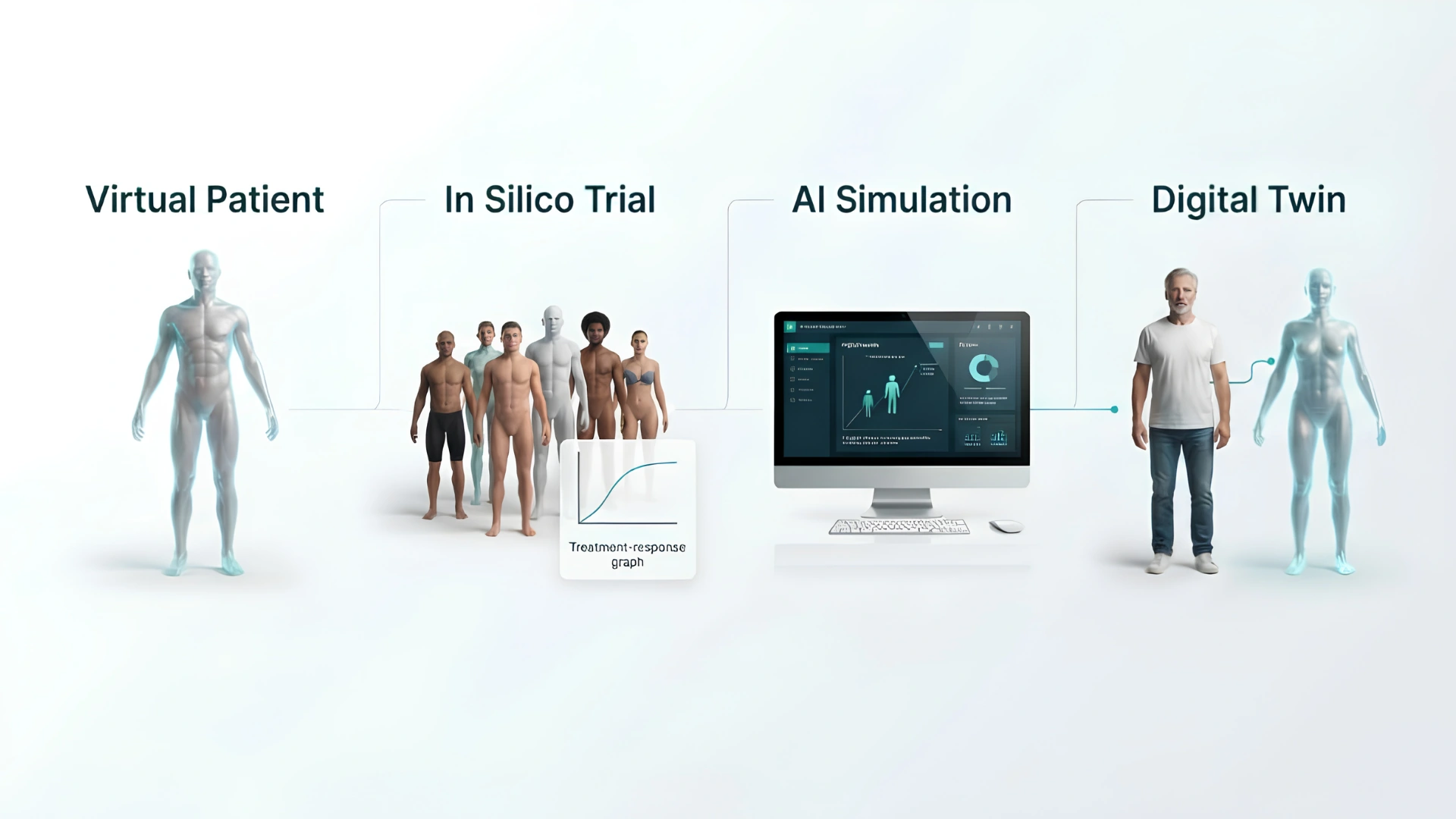
Virtual patients, in silico trials, AI simulations and digital twins
These terms are related, but they do not mean exactly the same thing.
|
Term |
What it means |
How it is used |
|
Virtual patients |
Computer-generated representations of patients or patient characteristics |
Explore how different people might respond to a treatment |
|
In silico trials |
Computer-based experiments that simulate some or all aspects of a clinical trial |
Compare treatments, doses, trial designs or predicted outcomes |
|
AI simulations |
Models that use machine learning or other AI methods to estimate outcomes |
Identify patterns and generate predictions from complex datasets |
|
Digital twins |
Digital representations of a specific patient, system or biological process, potentially updated with real-world data |
Model individual characteristics and explore possible outcomes over time |
An important distinction is that not every virtual patient is a digital twin. Some virtual patients are generated from population-level statistics or randomly sampled characteristics. A digital twin generally aims to represent a specific real-world entity and may be updated as new information becomes available.
Similarly, not every in silico trial uses AI. Some rely on established mathematical equations, statistical models or physiological simulations. AI can support these approaches, but it is only one part of the broader computational research landscape.
A 2025 peer-reviewed review in Cureus describes virtual patient cohorts as a potential tool for drug development, particularly where recruitment is difficult and researchers need to explore a wider range of patient characteristics. The review also identifies methodological limitations and the lack of standardized approaches as important challenges.
How AI-Powered Virtual Clinical Trials Work

The use of AI in clinical trials involves more than generating digital versions of people. Researchers need to build a model that connects patient characteristics, disease mechanisms and treatment effects to a specific research question.
Although individual platforms differ, the process generally follows several stages.
1. Collect and prepare relevant data
Researchers begin with data that may include previous clinical trial results, electronic health records, genetic information, laboratory measurements, disease characteristics and real-world treatment outcomes.
The data must be relevant to the drug, disease and patient population being studied. Researchers also need to check for missing information, inconsistent measurements, duplicated records and differences in how outcomes were recorded.
Poor-quality or unrepresentative data can weaken a model before a simulation even begins.
2. Build and train the model
Researchers use statistical methods, machine learning or mechanistic models to identify relationships between patient characteristics and clinical outcomes.
A model might examine whether age, genetic markers, disease severity or existing medical conditions are associated with differences in treatment response.
In some cases, AI identifies patterns across large datasets. In others, researchers combine AI with established biological knowledge to represent how a disease develops or how a drug interacts with the body.
3. Generate a virtual patient cohort
The model creates a simulated population designed to reflect the characteristics of the intended clinical trial participants.
This could include differences in age, sex, disease severity, genetic profile, existing treatments and other factors that influence eligibility or outcomes.
Researchers can use the cohort to examine whether a drug might behave differently across patient subgroups. These simulations can also help identify populations that existing research may not adequately represent.
4. Simulate treatment and trial outcomes
Researchers apply a simulated treatment to the virtual cohort and estimate potential outcomes.
Depending on the model, they may explore different doses, treatment durations, comparison groups, eligibility criteria or outcome measures. They can also test hypothetical scenarios that would be expensive, impractical or difficult to investigate directly in an early human trial.
The results are predictions, not observed clinical outcomes. Their reliability depends on whether the model captures the biological and clinical factors that matter for the specific question.
5. Validate the predictions
Before relying on the results, researchers need to assess whether the model performs well against independent or previously unseen data, established biological evidence and relevant clinical findings.
Validation should examine more than overall prediction accuracy. Researchers need to understand where the model performs well, where it fails, how uncertain its predictions are and whether its results remain reliable in different patient populations.
A model that predicts outcomes accurately for one disease or trial design may not perform equally well in another setting.
This is a central issue in the use of AI and machine learning in clinical trials. A simulation becomes useful when researchers can establish its credibility for a clearly defined purpose, not simply because it produces a plausible result.
How Virtual Patients Could Improve Drug Development

Virtual patient simulations could help researchers make better decisions at several stages of drug development. Their value lies in identifying useful evidence and potential risks before those questions become more expensive to answer.
Selecting promising drug candidates
Drug development teams often evaluate several experimental compounds or treatment strategies before committing to larger studies.
AI simulations may help compare these candidates by estimating their likely clinical effects, identifying weaknesses in their proposed mechanisms or highlighting patient populations in which a treatment might have limited benefit.
If a model consistently identifies a candidate as unlikely to produce a meaningful clinical improvement, researchers can investigate the underlying reasons before proceeding.
This does not mean an AI system should automatically eliminate a drug from development. An incorrect prediction could also cause researchers to abandon a potentially useful treatment. The results need to be interpreted alongside laboratory evidence, clinical expertise and other available data.
Improving clinical trial design
Trial design influences the quality of the evidence researchers collect. Poorly selected endpoints, unsuitable eligibility criteria or an inadequate study population can make it difficult to establish whether a treatment works.
AI-powered simulations could help researchers compare alternative trial designs before recruitment begins.
For example, a model could explore whether changing eligibility criteria would produce a more representative population, whether a different dose merits investigation or whether a proposed study is likely to generate enough information to answer its primary research question.
This could help teams identify avoidable design problems earlier and use resources more efficiently.
Improving patient selection and stratification
Patients with the same diagnosis do not always respond to the same treatment in the same way. Genetic differences, disease severity, coexisting conditions and previous treatment history can all influence outcomes.
AI tools for patient stratification in clinical trials could help researchers identify subgroups that may respond differently to an experimental medicine.
For instance, a model could identify a subgroup whose biological characteristics appear consistent with the drug's proposed mechanism. Researchers could then investigate whether those characteristics should inform eligibility criteria or a prespecified subgroup analysis.
Patient stratification must be handled carefully. Selecting only patients who appear likely to respond could improve the chances of observing a treatment effect, but it could also limit the evidence available for other groups. Trial designers need to balance the study's scientific objective with the need to understand who may benefit and who may face risks.
Supporting rare disease research
Rare diseases create a particular challenge for clinical development. The number of eligible patients may be small, and participants may be geographically dispersed or difficult to recruit.
Virtual patient cohorts could help researchers explore disease progression, estimate possible treatment effects and compare alternative study designs when the available clinical data are limited.
They may also help researchers identify which measurements are most useful for assessing treatment response.
However, a virtual cohort cannot manufacture reliable biological evidence that does not exist. If researchers have little information about a rare disease, the resulting predictions may be highly uncertain. Models need to account for that uncertainty rather than treating simulated patients as substitutes for missing clinical evidence.
Predicting treatment response and potential risks
AI models can explore relationships between patient characteristics, drug exposure and clinical outcomes. Depending on the available data and model design, they may help estimate which patients are more likely to respond or experience particular adverse events.
Researchers could use these estimates to identify questions that deserve closer investigation in a real trial.
The distinction between association and causation remains important. A model may detect that a particular characteristic is associated with a treatment outcome without establishing that the characteristic causes the outcome. It also may not capture rare adverse effects or biological mechanisms that were poorly represented in the training data.
For these reasons, simulated predictions should inform research decisions rather than replace direct evidence of safety and efficacy.
What Recent AI Trial Predictions Reveal

The October 2026 Reuters report offers a useful example of both the potential and the limitations of AI-based clinical trial prediction.
According to Reuters, Copenhagen-based BioinvestGPT shared predictions for six high-profile drug trial outcomes before the results were known. The company had correctly predicted five of the six outcomes reported by Reuters at the time of publication.
One prediction concerned del-desiran, an experimental treatment for a rare form of muscular dystrophy developed by Novartis. In July, BioinvestGPT simulated a trial using virtual patients and predicted that the treatment would produce an insignificant clinical benefit. The late-stage human trial subsequently failed to meet its primary goal.
Reuters also reported predictions involving Moderna and Merck's melanoma vaccine, AstraZeneca and Ionis' Wainua, Novo Nordisk's ziltivekimab and Vaxcyte's pneumococcal vaccine. BioinvestGPT's reported forecasts aligned with the outcomes in these cases.
These examples suggest that virtual trial models may identify weaknesses in a drug's expected clinical performance before a human study concludes. However, the results were reported by Reuters based on the company's predictions. They should not be interpreted as an independent, comprehensive validation of the model.
The incorrect prediction matters just as much
The same report highlighted a significant miss involving pelacarsen, a Novartis drug designed to lower levels of lipoprotein(a), a cholesterol-carrying particle associated with cardiovascular risk.
BioinvestGPT had predicted a positive clinical outcome. Novartis later reported that the late-stage trial did not show a reduction in the risk of a major heart attack or stroke in the studied population.
The company's subsequent analysis identified a problem with its interpretation of the drug's mechanism. According to Reuters, the model had failed to account for genetically determined differences in lipoprotein(a) particle size.
This example illustrates a basic limitation of predictive AI: a model can produce a confident answer while overlooking a biological factor that changes the result.
It also raises questions about how prediction accuracy should be measured. Six reported predictions are not enough to establish how a model will perform across the broader range of drugs, diseases and trial designs. Researchers would need larger, independently evaluated datasets, transparent methods and clear measures of uncertainty.
The lesson is not that virtual trials are ineffective. It is that their predictions need to be tested, scrutinized and interpreted in context before they influence major clinical decisions.
Can Virtual Patients Replace Human Clinical Trials?
No. Virtual patients can help researchers prepare for clinical trials, but simulated outcomes cannot independently establish that a medicine is safe and effective in humans.
Computer models work with the information and assumptions available to them. Human biology is more complex than any individual model can fully represent, and real patients may respond in ways that simulations do not anticipate.
Traditional clinical development generates evidence through progressively more extensive testing. Phase 1 studies generally focus on initial safety and tolerability, Phase 2 studies examine preliminary efficacy and dosing, and Phase 3 studies provide larger-scale evidence of efficacy and safety. The precise objectives vary by drug and development program.
Virtual simulations may help inform these stages, but they cannot automatically establish the same conclusions as studies involving actual participants.
Several limitations explain why.
- Unanticipated biological effects: A drug may trigger an adverse reaction or biological response that the model does not capture.
- Differences between simulated and real populations: Virtual cohorts may not adequately represent the diversity of people who eventually receive the medicine.
- Incomplete knowledge of disease mechanisms: A model may overlook a relevant pathway or incorrectly represent how a treatment works.
- Long-term safety questions: Some risks become apparent only after longer exposure or broader use.
- Regulatory evidence requirements: A model's output must be evaluated for its intended purpose and cannot automatically replace evidence required to support a regulatory decision.
The most realistic near-term role for AI is therefore to complement clinical research. Simulations could help researchers decide which questions to investigate, which trial designs to compare and which risks deserve additional attention.
They may eventually support smaller or more efficient trials in suitable circumstances, but any reduction in human participation must be scientifically justified and consistent with applicable regulatory and ethical requirements.
The Challenges of AI in Clinical Research
The potential benefits of AI in clinical trials depend on how reliably researchers can build, test and govern these systems.
Bias in training data
Historical clinical data may underrepresent certain populations or reflect differences in access to care, diagnosis and treatment. If those patterns are embedded in an AI model, its predictions may be less reliable for groups that were poorly represented in the original data.
Researchers should examine model performance across relevant demographic and clinical subgroups rather than relying only on an overall accuracy score.
Data quality and completeness
Clinical records and trial datasets are not always consistent. Measurements may be missing, outcome definitions may differ, and treatment practices may change over time.
A model trained on incomplete or outdated data may identify patterns that do not hold in a new trial. Data preparation, documentation and independent evaluation are therefore essential parts of the research process.
Privacy and data security
Virtual patient models may rely on sensitive medical records, genomic information and other personal health data. Researchers must consider how that information is collected, accessed, processed and protected.
Removing direct identifiers does not always eliminate privacy risks, particularly when datasets contain detailed genetic or clinical information. Appropriate safeguards, access controls and governance are necessary.
Validation and reproducibility
A model may perform well on the data used to train it but fail when tested on a different population or trial. Researchers need independent validation and a clear explanation of the model's intended use.
They should also document the data sources, assumptions, limitations and changes made to the model. Without this information, other researchers and regulators may struggle to reproduce the results or judge whether they are credible.
Transparency and explainability
Some AI models produce predictions that are difficult to interpret. In drug development, that can be a problem when a prediction influences decisions about patient safety, trial continuation or investment in a treatment.
Researchers need to understand not only what the model predicts, but also the evidence supporting the prediction and the conditions under which it may fail.
Regulatory credibility
A promising prediction is not automatically acceptable regulatory evidence. The credibility required depends on the model's intended use and the consequences of an incorrect result.
A model used to prioritize research questions may require a different level of assurance from one used to support a major decision about a drug's safety or effectiveness.
This is why regulatory discussions increasingly emphasize a risk-based approach to AI validation, documentation and oversight.
What FDA and EMA Guidance Means for AI in Drug Development
Regulators are developing approaches to assess AI in drug development without weakening the scientific standards used to evaluate medicines.
In the United States, the Food and Drug Administration (FDA) published its draft guidance, Considerations for the Use of Artificial Intelligence to Support Regulatory Decision-Making for Drug and Biological Products, in January 2025.
The draft proposes a risk-based credibility assessment framework for AI models intended to produce information or data supporting regulatory decisions about drug safety, effectiveness or quality. It emphasizes evaluating the credibility of a model for its specific context of use.
That distinction matters. A model does not need to be universally reliable for every possible task, but its credibility must be appropriate for the decision it is intended to inform. The FDA document is draft guidance, not a blanket authorization to replace clinical trials with AI-generated results.
The agency's Artificial Intelligence for Drug Development resource also describes its broader work on AI, including regulatory engagement and responsible implementation.
The European Medicines Agency's position
The European Medicines Agency (EMA) adopted its Reflection paper on the use of Artificial Intelligence in the medicinal product lifecycle in September 2024. The document discusses scientific and regulatory considerations for AI and machine learning across the lifecycle of medicines, from discovery through post-authorization activities.
The EMA's approach highlights the importance of data quality, model performance, human oversight, transparency and appropriate risk management. AI applications need to be assessed in relation to their intended purpose and potential impact on patients and public health.
The reflection paper is not a blanket approval of AI-generated clinical evidence. Instead, it provides a framework for considering where AI may be useful and what safeguards are needed.
Shared good-practice principles in 2026
The FDA and EMA have also collaborated on guiding principles for the responsible use of AI in drug development. The FDA lists Guiding Principles of Good AI Practice in Drug Development, published in January 2026, among its selected resources.
These principles support a common direction: AI should be developed and used with appropriate attention to human oversight, data governance, model performance, transparency, risk management and lifecycle monitoring.
For developers of virtual clinical trial platforms, this means that producing a prediction is only one part of the task. They also need to explain how the model was built, what evidence supports its use, what its limitations are and how its performance will be monitored.
Why the SURPASS initiative matters
On September 30, 2026, the US Department of Health and Human Services announced the SURPASS program through the Advanced Research Projects Agency for Health (ARPA-H), alongside complementary efforts intended to improve clinical trial development.
The initiative aims to combine computational models, real-time analysis, shared infrastructure and automation to make clinical development faster and potentially reduce the burden on participants.
SURPASS is an important sign of public-sector interest in new approaches to trial design. However, the announcement describes an effort to develop and evaluate these capabilities, not proof that virtual trials can already replace conventional human studies.
For researchers and pharmaceutical companies, the regulatory direction is clear: AI can create opportunities, but its role in a particular decision must be supported by appropriate evidence.
The Future of Virtual Clinical Trials
The future of AI in clinical trials will depend less on whether a model can generate thousands of virtual patients and more on whether its predictions consistently improve real research decisions.
The strongest early applications may involve comparing trial designs, identifying underperforming drug candidates, exploring treatment responses across patient subgroups and prioritizing questions that need further investigation.
Generative AI in clinical trials may also help researchers synthesize complex information, support protocol development and explore alternative scenarios. These applications should be distinguished from biological simulations that estimate actual treatment effects. Generating a plausible scenario does not establish that the scenario will occur in patients.
Agentic AI in clinical trials could eventually coordinate multistep research tasks, such as retrieving relevant evidence, checking study criteria and flagging inconsistencies for human review. But autonomous systems that influence trial operations or safety-related decisions would require appropriate controls, traceability and human oversight.
The commercial interest is growing, but the phrase AI in clinical trials market covers a broad range of technologies, from recruitment and trial operations to predictive modeling and virtual patient simulation. Market growth alone does not demonstrate clinical effectiveness.
The more meaningful measure of progress will be whether these tools improve the quality of evidence, reduce avoidable failures and help researchers make better decisions without introducing new risks.
Virtual patients could become an important part of that process. For now, their value rests on what they can help researchers investigate, how well their predictions hold up against real-world evidence and whether their use can be justified for a specific scientific purpose.
The goal is not to make clinical trials entirely virtual. It is to make the trials that involve real people more informative, better designed and more likely to answer the questions that matter for patients.